Showing posts with label The Missionary and the Brute. Show all posts

Saturday, March 3, 2012

*Guest Blogger* John D. Kenworthy Talks Literature, Education, and Building Schools in Tanzania "Brick by Brick"

The Terry Berg School at Ndoombo, Tanzania
[Guest blogger John Kenworthy is author of the chilling new novel The Missionary and the Brute, a thriller set in Tanzania, East Africa. Kenworthy's previous books have included The Hand Behind the Mouse: an intimate biography of Ub Iwerks and Bungee Jumping & Cocoons. He is the Founder/Executive Director of Brick by Brick for Tanzania!, Inc.]


Often times in my interviews people ask me why did I set The Missionary and the Brute in Tanzania, East Africa. It is a unique setting to be sure but not the usual one for a serial killer thriller. My answer to that question is similar to my response when people ask me why I chose to focus the efforts of my tax-exempt non-profit organization, Brick by Brick for Tanzania!, Inc., solely on Tanzania as well.

Well, why not?

It's a cheeky answer, but one that sort of cuts to the meat of the true response. Tanzania is often neglected in literature, in art, and in the public mind share. Aside from Hemingway's African novels and stories set around Mt. Kilimanjaro, there is precious little literature that takes place there. This may be one of many reasons that people truly don't know much about Tanzania in general at all. As such, it is often shoved to the side of any discussion of Africa and why it seems continuously marginalized.

The truth is that because I travel to Tanzania each year to build preschools for Brick by Brick, I know and love the country, the people, the culture to the point that I wanted to share that in a way that would have resonance - and writing is one way I can do so. I have tried to write several bucolic non-fiction works about Tanzania in the past, but they all seem to fall apart on me - they either seem too self-congratulatory or too soft or too something! So far my non-fiction hasn't captured that tight rope walk of horror and beauty in equal accord as I hope I did in my novel.

(Though the novel admittedly is twinged toward the horrific nature of human nature as well - which has little to do with any nation or ethnicity - simply is a fictive device.)

It is a bit ironic that the very attributes that make Tanzania so appealing to me as a humanitarian and as author are the very same that keep it from public discussion - it is peaceful, stable, quiet. There is neither genocide nor apartheid; no grotesque horrors of war or great natural disasters. They have droughts and famines to be sure - but not as publicly as do Ethiopia or Kenya even. They suffer in silence.

Nonetheless it remains one of the poorest nations in the world. Poverty - and extreme poverty at that - is the norm. The average income for a family in Tanzania is approximately $370 US dollars per year. From that money the families must feed, clothe, house, provide health care and if they are lucky educate their children just as do we. Imagine that. $370 a year! Some of our kids earn that in paper routes or allowances! And for what? PlayStation games and iTunes downloads?

That's not exactly for familial survival!

There is a huge need there to alleviate poverty - and in my eyes, education is the key. No change can come from within without having the populace better educated to embrace those changes from a vantage point of knowledge. The Missionary and the Brute can give new-comers to Tanzania a bit of an overview of conditions there and a sense of setting, but it does not have the didactic role of talking about that educational situation. So let me indulge my Brick by Brick side by telling you the rest of that story.
Education is very much revered in Tanzania. I have never spoken with a parent who didn't deeply desire their children to be educated. Sadly however, there are many factors from keeping that from happening effectively. It is a disappointing fact of life that only 57% of all elementary school aged children attend primary school. One of the primary reasons for this is the direct effect of poverty. The children are needed around the home to work in the shambas (the small fields) of the region. Part of this dilemma is exacerbated by younger siblings who must be cared for by the Mamas while the fathers are off working.

Our Brick by Brick preschools help alleviate that. By giving those younger children (3-5 years old) an active, safe nurturing, academic environment where they can prepare for the rigors of primary school, our preschools can give the mothers the ability to work in the shambas picking crops to barter for other food - or even to take jobs in the villages to supplement the family income. There are jobs available, and the women are willing to work. A more ardent, tougher group of individuals I have never seen than these mothers. They are strong, strong women whom I very much admire.

The effect of our schools on slightly older children is even more profound. Only 7% of all secondary school aged children attend school with less than 1% graduating. That's a 99% failure rate! Unacceptable! The reason these children drop out is plain and simple economics, they must work. As you can imagine the jobs available for a 13 or 14 year old child are not great. For young boys, often times it means getting strapped to a board and be lowered down mine shafts where their nimble fingers can be put of use. Frightening to think of our own kids doing such - and thereby equally unacceptable for the children of others. For young girls the jobs are even more horrifying. For many, prostitution is the only means by which they feel they can help the family.

I had a young girl - probably 14 or 15 - tell me that she was going off to the big city to be a prostitute. She was smart as a tack, had gone through a lot of school to that point and was aware that with the prevalence of AIDS in Tanzania she would probably be dead within two years. But to her, the only asset she had with which she could help her family was her body. That's a tragedy on so many levels and unthinkable to us in the US where we take so much for granted.

We have in five years seen the effects of our preschools on communities. I am regularly mobbed by sobbing Mamas who now have jobs knowing their young ones are safe in our Brick by Brick preschools. They hug me and thank me profusely. It is a sincere outpouring of love that I know we are doing good work there. We have followed up on graduates from our preschools too. For the first graduating classes, we are doing extremely well. At the Malaika School in Usa River - our longest running school - we have 100% of our students continuing on that path by attending primary school. That perfect record I know will not hold forever, but it is a great start. We are breaking that 57% cycle of failure.

We are achieving our modest goals.

It will not happen for Tanzania over night. There are so many schools to build. But we are doing so little by little each year. We take each day at a time. Small steps. One after the other. And together, brick by precious brick, we are making a difference. I have seen it.

This hope for the future that education provides is the other side of Tanzania. The light amid the darkness. And it is to this lightness that I cling and for which I work with all my heart and passion. Having seen with my own eyes the success amid the challenges, I can do no else.
It is what I do and why I revisit Tanzania constantly in my work and in my art...

John Kenworthy's Book Blog Tour continues tomorrow with "Kenworthy Interviews Author Raychelle Muhammad" at: http://www.raychelle-writes.blogspot.com/


Links:

The Missionary and the Brute on Amazon (paperback):

The Missionary and the Brute on Amazon (Kindle):
The Missionary and the Brute on publisher's site:

The Missionary and the Brute Blog:


Saturday, January 21, 2012

The Writer's Block: Week 2 in Review

I would like to express my gratitude to the authors who shared their stories this week on The Writer's Block. In case you missed it, here is a recap.

On Tuesday, we welcomed  children's author Jacquitta A. McManus (http://raychelle-writes.blogspot.com/2012/01/writers-block-interviews-jacquitta.html).


On Wednesday, we visited with children's author and storyteller Dianne de Las Casas (http://raychelle-writes.blogspot.com/2012/01/writers-block-interviews-dianne-de-las.html).


On Thursday, we met John D. Kenworthy, an author and philanthropist (http://raychelle-writes.blogspot.com/2012/01/writers-block-interviews-john-d.html).


And on Friday, we were introduced to YA Fantasy/Paranormal author Alivia Anders (http://raychelle-writes.blogspot.com/2012/01/writers-block-interviews-alivia-anders.html).


I encourage you all to take a few minutes to read their interviews and even leave a comment. I think that you will be inspired. I think that you may learn something new. I think that you will broaden your perspective. Hopefully, you will be forever changed for the better as I have.

Many thanks to The Writer's Block contributors! I salute you all.

Keep your pen to the paper! Remember, inspiration is everywhere...

Thursday, January 19, 2012

The Writer's Block Interviews John D. Kenworthy


1) Describe your journey as an author/writer.
 
My journey as an author has taken a familiar path to most artists. Early on in my life I knew that I had some things to say, but not necessarily the facility by which I could share them. I learned that writing was a means to express the passion and compassion within myself that I struggled to share through more conventional means. I had severe speech impedimenta as a child but it took me not long to realize that I did not stammer when I wrote. Kurt Vonnegut wrote of it once - or perhaps I merely dreamed that he had - using a metaphor that explained that he was a clumsy kid, but in the water he could swim quite gracefully. Writing is like that to me. Upon the open water of the page, I can swim.

So I nurtured that within myself. I read voraciously and wrote every second I could. I always was a writer - as long as I had consciousness I knew that I was a writer. Some folks would say, "Wow, Kenworthy, you should be a writer!" and I would always respond, "I am." Writing and publishing were two separate entities to me, and still are. I'm not caught up in the ego-massaging world wherein I have to have a best seller or a Pulitzer Prize to validate to myself what I do. It is the process of writing that I love. Don't get me wrong, I'd love to have readers buy my books - no question. Writing solely for yourself is a sort of sad literary masturbation in my eyes, so it must be shared. But the success for me isn't defined by lists or awards though they are indeed wonderful when they occur.


2) Do you specialize in any particular genre(s)?


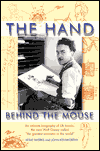
I have always considered myself to be a genre hack or maybe it's more like an anti-snob. I tend to write in a variety of forms and even styles to fit my eccentric personality. All writing is valid. I have written PRs for my company, screenplays for an animation studio in Denmark, sleazy biker fiction for Easyrider's Magazine; a straightforward biography for Disney (The Hand Behind the Mouse: an intimate biography of Ub Iwerks, Disney Editions 2001, winner of the E.G. Lutz Award for best book about animation). I have written pop-theology, industrial marketing manifestos, poems and proverbs and epistles of every ilk. My work has been for children, for adults, for bad girls and good boys, and yet it shares a thread of something that is uniquely me - and that is my voice. In the best of my work I believe it is that lyrical voice that sustains it, that carries it, that makes it resonate within the reader regardless the subject, style or audience. Or at least that is the hope. For me, The Missionary and the Brute is the culmination of that expression of voice.


3) What was your first published work?

My first published work of any kind was a short story called "Biker's Funeral" which appeared in Easyrider's Magazine back in 1987. It was an incredibly fast paced tale of two bikers stealing the corpse of their deceased friend and taking him to a party across country strapped to the back of one of their bikes. It actually got rejected at first. They sent my manuscript submission back to me with diacritical marks absolutely covering each page. Hundreds of edit marks! It was disappointing at first, but after I thought about it I realized it must have been pretty close for them to take that time to copy edit it. So I accepted all their edits, and then re-wrote some more - trying to think of any objections the editors might have. One thing I knew had to go from the original was that I included the character of Grace Slick of Jefferson Airplane in one scene. That probably would have gotten all of us sued! So I took her out and in her place created a fictional songstress. Maybe that did it. When I resubmitted, it got published. That was one of those great moments in life where everything clicked. I was floating on air for months after that. It had some great lines in it as I recall and I got asked to write a series of funny and edgy biker tales for Easyrider's and their sister magazines after that. Lots of fun. I could be as outrageous as I wanted to be.


4) Tell us about your most current project, The Missionary and the Brute.


The Missionary and the Brute is an adult literary novel that imagines what it would be like to be arrested for murder amid the brutal conditions of a far off land. Traveling in Africa is challenging enough without being involved in a serial murder case at the same time. We observe as the Missionary Jadwin Ross discovers the truth behind the killings and realizes that innocence is a relative term. In many ways, the book is about the duality of humankind - that we simultaneously have elements of both the missionary and the brute within us all. One gravitates toward matters of civility and conscience, while the other acts on base animal instinct and intuition. During the novel, they seem to race headlong toward a riveting conclusion that is as unexpected as it is final.


5) How did you choose a publisher?

The Missionary and the Brute is published through CreateSpace, an Amazon company. I know that the writing, subject and style of this gritty, compelling novel are complex and beyond the comfort level of many traditional publishers. It's also not easy to summarize in a pithy tag line with which to query agents. Beyond that, I wanted to have the control to publish it my way. There is no one to blame for either the success or failure of this work other than me. I dig that. Accountability and responsibility are mine.

So if you enjoyed Fight Club, American Pscyho, Out of Africa, or Harry Potter rush out and buy one today! (Okay, it truly has nothing to do with Harry Potter, but I wanted to expand my audience!) Available now at Amazon.com.


6) Tell us about Brick by Brick for Tanzania!, Inc.

For as dark as The Missionary and the Brute is in regards to events transpiring in Africa, my work as founder/Executive Director of Brick by Brick for Tanzania!, Inc. is just that much light. Brick by Brick is all about hope. It is our mission to help the children of Tanzania and their families by building preschools. Our schools help in a number of ways - the three primary ways they help are: 1- they provide an academic head start for boys and girls of all walks of life in a safe, nurturing environment, 2- because the students are cared for the mothers can now take work outside of the home to supplement meager family incomes (approximately $370 USD per family, per year), 3- since the mothers are working, older siblings don't have to - only 7% of all secondary school aged children attend school because they are sent off into a harsh and unyielding workforce. As you can imagine the jobs available for a 13 or 14 year old are not pleasant. Often they are harsh and dangerous (sending boys down into mine shafts) or downright deadly (girls turning to prostitution to help their families). Our schools aim to help in each of these areas. They also have a couple of other more subtle outcomes - many of the children are extremely poor and are facing severe hunger situations. Sometimes the porridge they eat in our schools is their only meal of the day. We never anticipated that benefit. We are also told by embassy personnel that our schools serve a strong diplomatic purpose, helping share what is best about the west with the people of Tanzania. That too was unforeseen, but greatly welcomed.


7) How do you promote your work? What strategies have been the most successful?
Begging friends and family has been fairly effective for me thus far. Ha! And I wish that was more of a joke than it in actuality is. It is darned difficult to self-promote, but it is essential. With my first books, I learned that I bore the responsibility for the success or failure of my own sales efforts. I do a lot of social media - Twitter, Facebook, LinkedIn, GoodReads - all linking to my blog and online store. I am currently doing a direct mail campaign to independent booksellers with an interactive multimedia DVD trying to generate interest in my making appearances for book signings/readings/talks/book clubs. That person to person marketing is the absolute best sales tool and word of mouth is huge - especially for a challenging book such as mine.


8) What advice would you give to budding writers?

Write. It is as simple as that. Too often I hear folks talking about what they are going to write, but never actually doing anything. Often they are great ideas too. Unfortunately, speaking from experience, if you share a story verbally too many times it no longer has that psychic necessity to become a book. You have sated that storytelling gene we all carry within us. (It's the 21st or 22nd one beyond the penultimate turn of that double helix thingy.) The other thing I would tell budding writers is to expect rejection but to learn from it. I have a stack of rejection letters nearly 3 inches thick. I have learned from each one - even the crappy form ones. Put yourself behind an unseen reader's eyes. See the book as they see it. Pull away and give yourself distance so that you can be objective about your own work. That's so tough to do but essential. Once you learn to do that with an unerring editorial touch, you will know not only where you have failed the reader, but where you have achieved that greatness you seek. When that happens - and it will if you are dogged at it - that is the most magical feeling in the world!


9) What is your definition of success as a writer?

I believe every writer has to write their own definition of success. What works for me certainly wouldn't work for everyone. Right now - I just want to get my works out there. A few hundred copies here and there and I am fine with that for now. I think it's all about people finding me. Or me them. For me, I definitely want to sell books, but on my terms. I am independent enough to really want to share my voice more than to reap great sales. I think my writing voice is the most unique aspect of not just my books but my life. So my ultimate success would be being able to write full-time so that I can share that voice more frequently. I'm on the path to that right now, but time as always shall be the great arbiter of those kinds of decisions.


Author Bio


John Kenworthy has written for Easyriders, Biker, V-Twin and Persistence of Vision magazines. He is the co-author (with Leslie Iwerks) of The Hand Behind the Mouse: An Intimate Biography of Ub Iwerks (Disney Editions, 2001) winner of the E.G. Lutz Award for best book about animation, and is author of Bungee Jumping & Cocoons (ISA Press, 2003). The Missionary and the Brute is his first novel.


Website link: http://missionaryandthebrute.blogspot.com/

Twitter handle: @John_KENWORTHY

Blog link: http://missionaryandthebrute.blogspot.com/

Facebook link: http://www.facebook.com/john.kenworthy